Study at the University of Basel
Basel, Switzerland
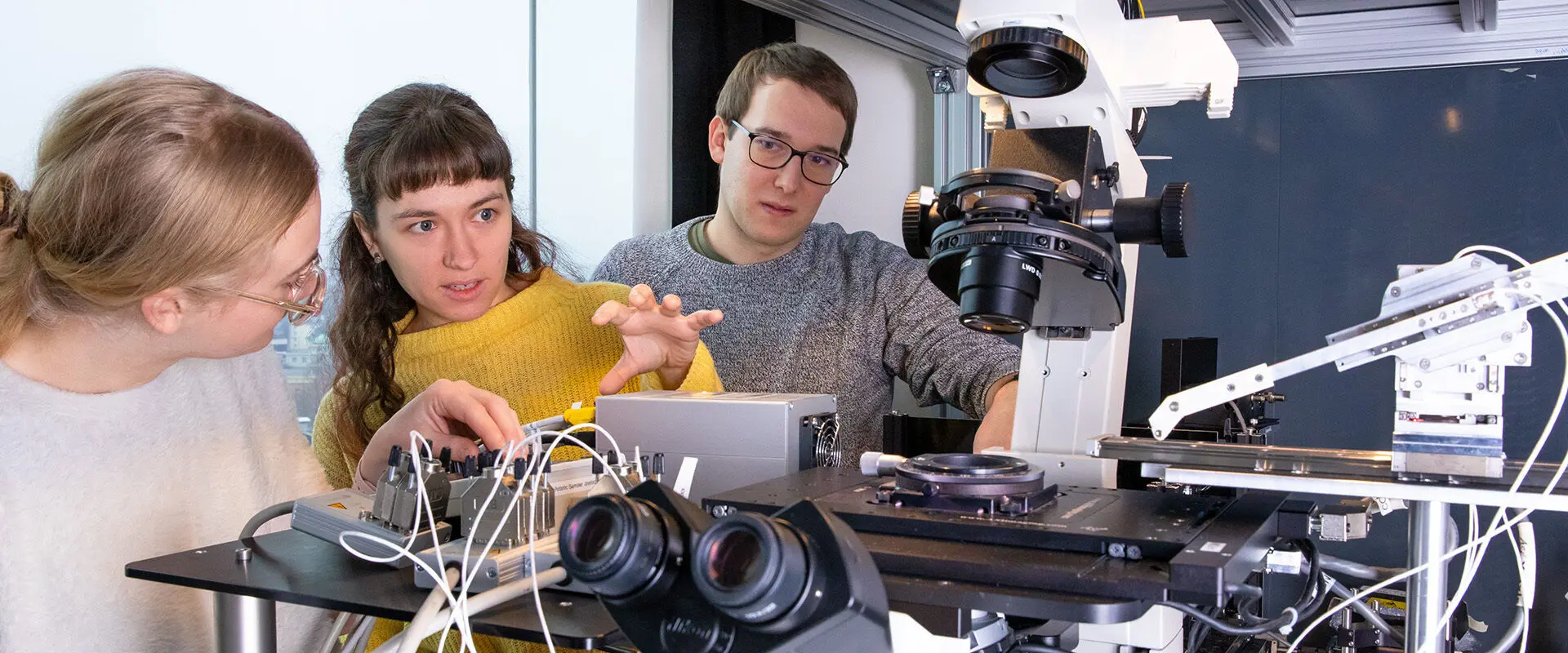
Photo by University of Basel
| Programme details | |
|---|---|
| Degree: | Master of Science (MSc) |
| Disciplines: |
Physics
Biology Natural Sciences Molecular Sciences |
| Duration: | 1.5 years |
| ECTS points: | 90 |
| Study modes: | full-time |
| Delivery modes: | on-campus |
| University website: | Physics of Life |
The Master's degree program in Physics of Life provides training in cutting-edge biophysics research at the interface of physics, mathematics, engineering, and life sciences. The MSc Physics of Life is designed for students who have obtained Bachelor’s degree in physics, mathematics, or computer science.
The degree program has small class sizes, personal mentoring, and includes courses and research training in both experimental and theoretical approaches in biophysics.
The MSc Physics of Life is hosted by the Biozentrum of the University of Basel, which is one of the world's leading institutes for basic research and teaching in molecular life sciences.
Visit the MSc Physics of Life page on the Biozentrum website for more details.
The MSc Physics of Life is a 3-semester (90 CP) course, where 60 CP are obtained through individual research projects and 30 CP are obtained through advanced courses with small class sizes. In the first two semesters, you will complete the courses and the two research projects. In the third semester, you will focus on your MSc project.
Research projects: The MSc Physics of Life offers courses and research training in both experimental and theoretical approaches. The major focus of the MSc Physics of Life program are your individual research projects with personal mentoring:
Advanced courses: You will supplement the research training by completing foundational lecture courses in physics of life, with small class sizes. Additionally, you will take courses in your fields of choice, which may include lectures from physics, mathematics, computer science, biophysics, computational biology, bioinformatics, chemistry, cell biology, genetics, developmental biology, structural biology, microbiology, infection biology, immunology, neurobiology, and pharmacology – a wide variety of options for theoretical and experimental topics are available!
Learning objectives: Through the combination of coursework and research projects within the MSc Physics of Life program, you will be able to identify important biological research questions and deploy appropriate physical, mathematical, or biological methods to address these questions. You will also have the practical experience to complete a research project and the skills to communicate your results.
Language: The degree program is taught in English.
Scholarships: A limited number of scholarships for international candidates with outstanding records of accomplishment are available.
Physics of Life research at the University of Basel includes both theoretical and experimental research, on a wide variety of topics that span many length scales of living processes, including macromolecular structures & biophysics, cellular physics, multicellular physics, neuroscience, systems biology, and evolutionary dynamics.
The Master of Science in Physics of Life opens up diverse career perspectives. These include a research career at a university or in industry, work in the lab or at a school, in a patent attorney firm or in consulting, biocomputing, or science journalism. With your knowledge of biological processes and your training in quantitative methods, many doors open for you in biomedicine, biotechnology, the pharmaceutical and food industries, at universities, or in public organizations.



Visit the website of the University of Basel to find out how to apply and start your study-abroad adventure in Switzerland! 🙌