Study in Finland
Finland: located in Europe's far North, it offers one of the best higher educational systems

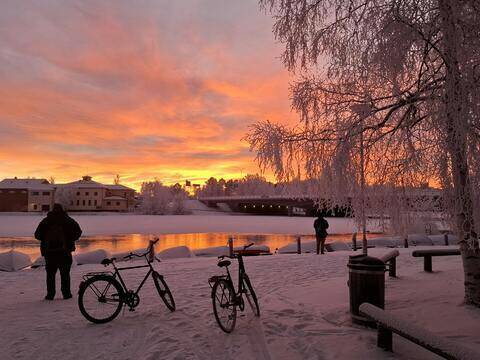
Helsinki, Finland by Sami C, CC BY 2.0, modified
|
Study in Finland – Facts 
|
|
|---|---|
| Capital: | Helsinki |
| Other popular student cities: | Tampere, Oulu, Turku, Kouvola |
| Population: | 5,414,000 |
| Currency: | EUR 1 EUR = 1.15 USD |
| Listed universities: | 40 |
| Study programmes: |
151 Bachelors
499 Masters 71 PhDs |
| Ranked universities: | 10 |
| Look at study programmes in Finland 🧑🎓 | |
Consistently ranked as the world’s happiest country, Finland offers a unique environment where wellbeing, balance, and quality of life are deeply embedded in everyday life. Something that strongly appeals to students moving abroad.
Located in the far North of Europe, Finland has become a great destination for international students looking for high-quality education, innovative teaching methods, and a modern lifestyle. While tuition fees for non-EU students have been introduced in recent years, the country still stands out for its excellent value for money.
Studying your Bachelor’s in Finland or your Master’s in Finland means adapting to distinct seasonal rhythms: long, bright summer days where the sun barely sets, and cold, dark winters that create a cosy atmosphere perfect for indoor social life. This contrast plays a big role in student activities and lifestyle throughout the year.
In summer, students make the most of the outdoors. It’s common to go hiking in national parks, swim in lakes, enjoy barbecues by the water, or travel with friends during the long daylight hours. A highlight of the year is the celebration of the summer solstice, when locals and students gather to enjoy the longest day of the year.
During winter, student life becomes more indoor-focused. Students often take part in sauna culture, join university clubs and societies, attend student parties, or enjoy winter sports such as ice skating, skiing, and even northern lights trips in the north of the country.
The main language is Finnish, although Swedish is also an official language due to Finland’s historical ties with Sweden. However, international students will find that most universities offer a wide range of English-taught programmes.
After the alignment of the European educational systems as part of the Bologna reform, many universities and universities of applied sciences in Finland have increased the number of English-language Bachelor and Master programmes.
Finland has about 40 institutions of higher education, which are commonly classified into either universities (classical research and teaching institutions) and universities of applied sciences (with a more practice-oriented approach to teaching). There are slightly over 300,000 students enrolled in Finland, about 20,000 of which are international students.
Here are some of the leading universities:
For students from the EU/EEA, most academic programmes are free of charge.
For international students from outside the EU/EEA, tuition fees in Finland typically apply at Bachelor’s and Master’s level. These usually range from around €6,000 to €18,000 per year, depending on the university and programme. Fields such as business, technology, and design are often on the higher end of this range. However, many universities offer generous scholarships, sometimes covering 50% or even 100% of tuition fees for high-achieving students.
The cost of living in Finland is moderate to high compared to other European study destinations, with students typically needing around €800 to €1,200 per month. The biggest expenses are rent and daily living costs. Student housing is usually well-organised through student unions, offering more affordable accommodation options compared to the private rental market.
Finland offers a strong job market for graduates, particularly in technology, engineering, healthcare, education, and sustainability, with salaries that are generally high compared to many other European countries. This is why studying in Finland can be considered a worthwhile investment in your future career. However, one important factor to keep in mind is language: While you can study in Finland in English, learning Finnish is essential for finding a job and for integrating into society. Even basic language skills can make a significant difference when it comes to internships, networking, and long-term career prospects.
Finland is located at the Northern edge of Europe. Helsinki Vantaa, in the capital, is one of the more important airport hubs in the Nordic region with many international flights. Via Finnair, there are especially convenient connections to East Asia and China in particular. Smaller airports in the rest of the country are sometimes serviced by low-cost carriers such as Ryanair, but are otherwise connected via Helsinki.
Cities like Helsinki, Tampere, and Turku are consistently ranked among the best student cities in Europe, offering a great balance between nature, innovation, and student life.
Search universities & programmes in Finland
.svg "HAMK Häme University of Applied Sciences")

.svg "University of Helsinki")