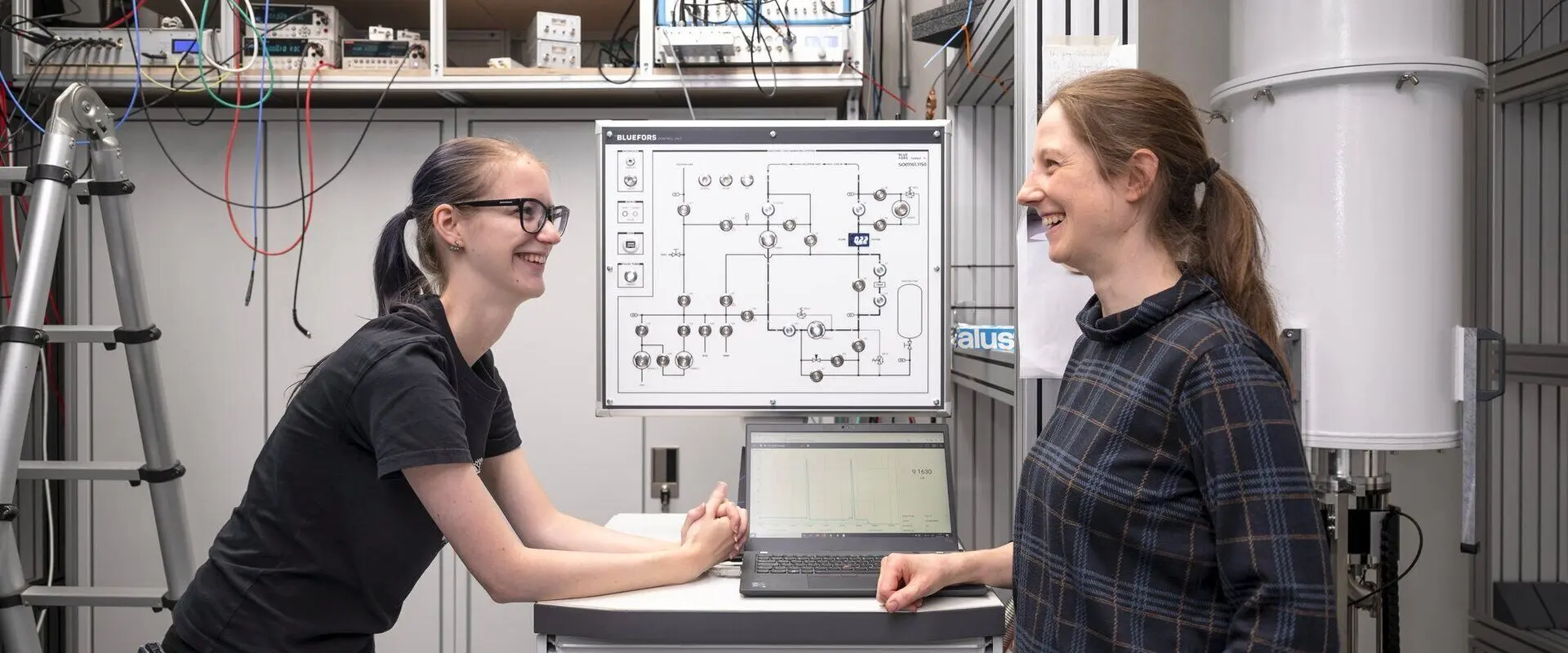
Physics traces natural phenomena back to quantitative relationships (experimental physics) and mathematically formulated laws (theoretical physics) through experiments, observation and measurement.
The division into the two subfields corresponds to the two types of physical research, namely, on the one hand, to ask specific questions of nature and to fathom them through experiments and, on the other hand, to interpret the results with the help of mathematical and numerical methods and to predict new facts.
Focal areas of teaching and research
The Department of Physics at the University of Basel successfully participates in cutting-edge research in important and fascinating areas of physics:
- Nano- and Quantum Physics: In nanophysics, different laws apply than in our everyday experience. We experimentally investigate electronic and optical properties of novel materials using high-resolution microscopes down to the atomic scale. This fundamental research enables applications ranging from nanoscale sensors to medical diagnostics and energy technologies. Nanophysics in Basel is leading in Switzerland through close collaboration with the Swiss Nanosciences Institute (SNI) – the national center of excellence that promotes interdisciplinary research and technology transfer.
With the developed nanoscale models and technologies, we open the door to quantum physics and explore its revolutionary concepts at the highest level – whether in superconductors or semiconductors, magnets, graphene, topological systems, or ultracold gases. This quantum research is coordinated by the Basel Quantum Center (BQC), which unites 16 research groups and consolidates quantum research activities in the trinational Basel region.
- Cosmology and Particle Physics: From the smallest particles to the largest structures of the universe, we explore fundamental questions of physics. We investigate subatomic building blocks of matter and their role in the development of the universe – from quantum fluctuations to the formation of galaxies and supernova explosions. Central mysteries are our focus: for example, the origin of matter-antimatter asymmetry or the nature of "dark matter." Our research advances the Standard Model of particle physics and searches for a unified theory of all fundamental forces, from supersymmetry to the integration of gravitation as a quantum theory.
Combination of subjects:
The study programs of the Faculty of Science are basically mono study programs with options for specialization and an elective area.
Physics is studied in the Bachelor's and Master's program as a course of study without additional subjects. In addition, it is possible to study physics as an extra-faculty bachelor's and master's degree subject with a subject from the Faculty of Philosophy and History or as a second subject to sports science.
Career opportunities:
More than 2/3 of the graduates initially stay in higher education for a few years to pursue a doctorate. Career prospects are good; due to the low number of students, this will remain the case for the foreseeable future. Many fields of activity are open to physics graduates, for example in:

- Manufacturing industry (mechanical engineering, watchmaking, high-tech, electrical, chemical and optical industries, microtechnology, software)
- Research and development (industry and public/private research institutes)
- Teaching (high schools, universities)
- Medicine (e.g. medical physics)
- Communication, science journalism
- Public administration (testing, calibration and patent offices)
- the financial world (consulting, banking, insurance, risk assessment)
- others (transport, energy and safety specialists, personnel services)