The academic backgrounds of the world’s most powerful CEOs
The academic backgrounds of...
In an exclusive study, we reveal the academic backgrounds of the world’s top CEOs. We address a range of interesting questions: Do CEOs need an MBA or even a Master’s degree? How important is international academic experience? And how many women hold the top management posts?
Read on to learn the answers to these and other questions:
As the basis for our analysis, we picked the largest companies on each continent as per the Forbes Global 2000 company ranking. In total, the analysis includes the backgrounds of 283 top company leaders.
For each of them, our analysis considered
In the article below, we highlight the findings of this survey.
Chief Executive Officers are generally well-educated professionals. Globally, 98% of the sample hold at least a Bachelor’s degree; 64% hold at least a Master’s degree or equivalent (including MBAs); and 10% hold a Doctorate degree.
There are some notable regional differences:

Over the past decades, many studies have found a strong correlation between the diversity of executive or advisory boards and the financial performance of companies, especially with regards to gender diversity. Recent studies include, for example, “Is Gender Diversity Profitable? Evidence from a Global Survey” by the Peterson Institute and EY, or the Women Matter report by McKinsey & Company.
The rationale is that diversity allows teams to approach problems from various perspectives, avoiding the risks of a “yes men” herd mentality. Of course, this is true on any level within an organisation, and not just the top leadership.
However, the top management position is generally still a male domain: Only 4.6% of the CEO posts in the data sample are held by women. Out of the mere thirteen female CEOs, six are heading US-American companies.
In contrast, the share of CEO posts held by foreign nationals is relatively high: 26% were born and raised in other countries than their corporation’s headquarters. That ratio is highest in Europe with 43% and Australia with 41% (predominantly from the UK and New Zealand); yet lowest in Asia with only 11%.
Although it is no replacement for actual diversity in teams, studying abroad is a great way for individuals to leave their comfort zone, get to know foreign cultures and concern themselves with new perspectives at a young age. That is one reason why top managers who studied overseas are generally in high demand for important positions.
54% of North American CEOs, and also 54% of Latin American CEOs hold MBA degrees. That means that in those two regions, almost all of those with any Master’s degree hold a Master of Business Administration.
That share is significantly lower in Europe: While the share of CEOs with a Master’s degree is higher (74%), only around one third of those went to business school to get an MBA. Instead, technical, scientific or legal degrees are the norm among European company leaders.

The data shows that 36% of the world’s top CEOs studied abroad for at least one semester (up from 32% four years before). Depending on what sources you trust, only around 6% to 10% of all tertiary students worldwide get to go abroad during their studies; and that number, of course, does not even account for all those that do not get the chance to attend university at all. In any case, it is safe to say that when it comes to study abroad experience, CEOs exceed the average by far. Conversely, that means students that want to lay the groundwork for one day becoming CEOs should consider to study overseas.

Surprisingly, although most of the world’s global players are US-based, among all CEOs in the sample, the Americans have the least international experience: Only 13% studied abroad. In contrast, 68% of African CEOs went abroad to study, the highest value for any region in our dataset.
Analysing the data further, we reveal an interesting trend: Looking only at the younger third of CEOs, the share of those who studied abroad rises to 41%. This fits well with the global long-term trend of increasing student mobility (see, for instance, the OECD). It is much more common among today’s students to spend part of their studies abroad. And it implies that future generations of CEOs are even more likely to have studied abroad at some point during their academic education.
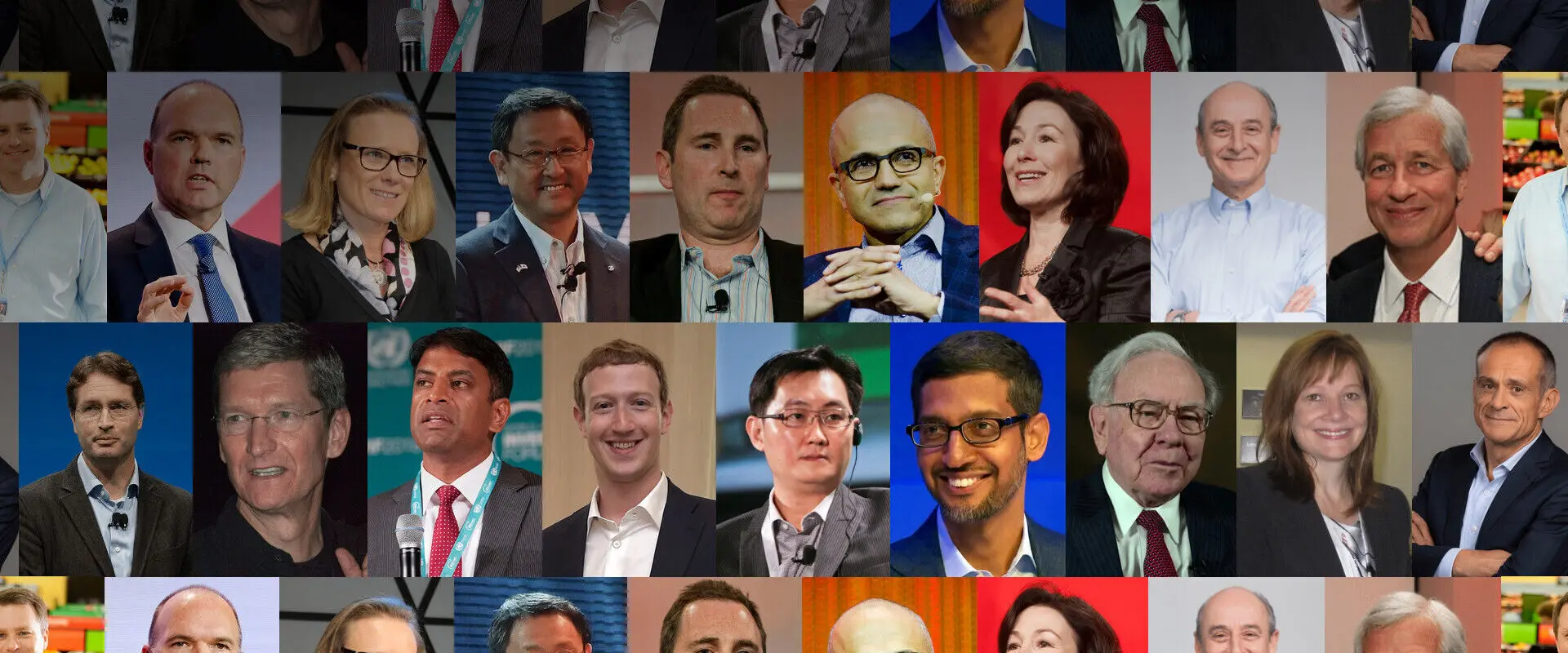
Cover photo collage credits: Mary Barra; Doug McMillon by Walmart (CC BY-3.0); Warren Buffett; Mark Zuckerberg by Presidencia de la República Mexicana (CC BY-2.0); Satya Nadella by Dan Taylor/Heisenberg Media (CC BY-2.0); Tim Cook by Valery Marchive (CC BY-SA 2.0); Akio Toyoda by Moto "Club4AG" Miwa (CC BY-2.0); James Dimon by Financial Times (CC BY-2.0);Ola Källenius by Matti Blume (CC BY-SA 4.0); Andy Jassy by JD Lasica (CC BY-2.0); Nick Read by Graham Carlow (CC BY-2.0); Ma Huateng by TechCrunch (CC BY-2.5); Vasant Narasimhan by UNCTAD (CC BY-SA 2.0); Safra Catz by Oracle PR/Hartmann Studios (CC BY-2.0); Jean-Pascal Tricoire by Schneider Electric (CC BY-SA 4.0); Eduardo Padilla Silva by Guachoo (CC BY-SA 4.0); Sundar Pichai by Aimerou (CC BY-SA 4.0); Belén Garijo by Merck (Darmstadt, Germany) (CC BY-SA 3.0); collage licensable under CC BY-SA 4.0 crediting Study.eu with hyperlink to this website. See CC BY 2.0, CC BY-SA 2.0, CC BY 2.5, CC BY 3.0, CC BY-SA 3.0, CC BY-SA 4.0.
23445 Programmes in Europe

.svg "Central European University (CEU)")
.svg "Radboud University")
.svg "University of Helsinki")
.jpg "Top 10 Best Universities for Journalism in Europe in 2026")

